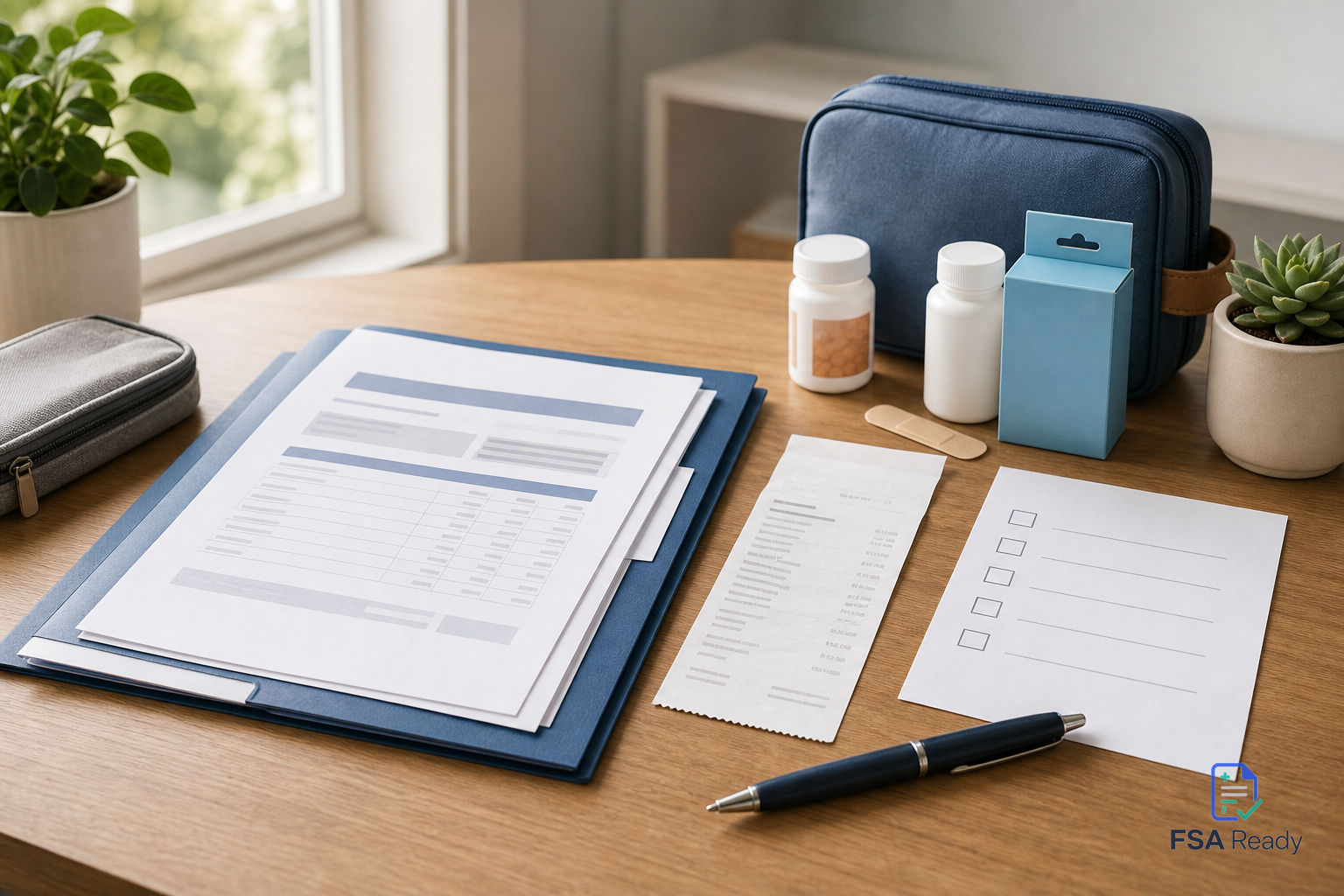
FSA documentation is the paperwork that helps your plan administrator understand what happened, what you paid, and why the expense may qualify. FSA claims usually do not fail because someone bought something strange. They fail because the paperwork does not prove enough.
A card swipe, order confirmation, or bank charge can show money moved. It may not show the expense was eligible under your plan. That is the gap your claim packet has to close.
The plain English answer
For most FSA claims, you want FSA documentation that shows five basic things:
- What you bought or paid for
- The date of purchase or service
- The merchant or provider
- The amount you paid or owe
- Why the expense may qualify under your FSA rules
For some claims, an itemized receipt is enough documentation. For others, you may also need an Explanation of Benefits, prescription, provider note, or Letter of Medical Necessity. It depends on the expense type and your plan administrator's rules.
The annoying part is that the charge itself is rarely enough. Your plan needs to connect the dollars to a specific eligible or possibly eligible health expense.
Key terms worth knowing
Itemized receipt
An itemized receipt breaks down the purchase line by line. It should show the product or service name, purchase date, merchant or provider, and amount. A credit card slip that only says “pharmacy” and “$42.19” is usually weaker because it does not show what you bought.
Explanation of Benefits
An Explanation of Benefits, often called an EOB, comes from your insurance company. It may show the provider, service date, service type, amount billed, amount covered by insurance, and patient responsibility. For medical, dental, or vision care, an EOB can be useful because it helps show what portion you may be responsible for.
Letter of Medical Necessity
A Letter of Medical Necessity, or LMN, is a note from a licensed health care provider explaining why a product or service is needed to treat, diagnose, mitigate, or manage a specific medical condition. Some expenses are plan-dependent and may need this extra documentation before they are considered.
Plan administrator
Your plan administrator is the company or office that reviews claims and applies your specific plan rules. They make the coverage call for your FSA. Store labels and online eligibility badges can help, but your plan's rules still control the claim review.
Common confusion points
A receipt is not always the same as an itemized receipt
People often upload the easiest proof they have: a card slip, email total, app screenshot, or bank transaction. Those can be useful backup, but they may not show enough detail by themselves.
A stronger receipt says exactly what was purchased. “Sunscreen SPF 50” is much clearer than “health and beauty.” “Office visit copay” is clearer than “medical payment.”
FSA card approval does not end the paperwork
Even if an FSA card works at checkout, your administrator may still ask for substantiation later. That request is not automatically a sign that you did something wrong. It often means the system needs clearer proof of the expense.
Keep your receipts even when the card transaction goes through.
HSA and FSA rules can feel similar, but the process can differ
FSA and HSA eligible expense lists often overlap, but the account rules, recordkeeping expectations, and review process can differ. FSAs commonly involve administrator claim review. HSAs often put more responsibility on the account holder to keep records.
That does not mean you should treat HSA receipts casually. If a question comes up later, clear records are still your friend.
General wellness language can weaken a claim
Some products sit in a gray area. “Wellness,” “self-care,” “comfort,” or “general health” language may not be enough. If an item is only possibly eligible when used for a medical condition, your plan may ask for stronger documentation, such as an LMN.
The tradeoff is simple: the more borderline the expense, the cleaner the paper trail needs to be.
Questions to check before you submit
Before uploading a claim, slow down for two minutes and ask:
- Does the receipt show the exact product or service?
- Does it show the purchase or service date?
- Does it show the merchant, pharmacy, provider, or clinic?
- Does it show the amount paid or patient responsibility?
- Is the expense clearly medical, dental, vision, or prescription-related?
- If the item is dual-purpose, could your plan require a Letter of Medical Necessity?
- If insurance was involved, do you have an EOB?
- Are you submitting only the unpaid or out-of-pocket portion?
- Does your plan require a specific claim form or upload format?
- Is the claim within your plan's submission window?
None of these questions decides eligibility by itself. They help you spot missing proof before your administrator does.
Simple FSA documentation checklist
Use this as a basic FSA documentation prep list. Your plan may ask for more or less depending on the expense.
- Itemized receipt or invoice
- Date of purchase or service
- Merchant or provider name
- Product or service description
- Amount paid, charged, or owed
- EOB, if insurance processed the claim
- Prescription, if required for the item
- Letter of Medical Necessity, if the expense is plan-dependent or dual-purpose
- Completed claim form, if your administrator requires one
- Notes explaining what each file is, if the upload portal allows comments
A clean packet is boring in the best way. The reviewer should not have to guess what happened.
What to do if your documentation is thin
If you only have a partial receipt, do not panic. You may be able to collect better proof before submitting or resubmitting.
Try checking:
- Your online pharmacy or retailer account
- Provider billing portals
- Insurance member portals
- Email receipts
- The merchant's receipt lookup tool
- Your provider's billing office
- Your plan administrator's claim instructions
If your administrator already denied or pended the claim, read the reason carefully. “Need itemized receipt” is different from “expense not eligible” or “need medical necessity documentation.” Match your resubmission to the actual reason, not to what you hoped they meant.
Informational disclaimer
This article is for general information only. It is not tax, legal, medical, financial, or benefits guidance. FSA and HSA rules can vary by plan, administrator, expense type, timing, and documentation requirements. Always verify eligibility, deadlines, and required documentation with your plan administrator before buying, submitting, or resubmitting a claim.
A cautious closing
Good documentation does not force a plan to approve a claim. It just gives the reviewer a clearer file and gives you fewer avoidable problems.
If you are unsure, treat the claim like a tiny case file: receipt, date, amount, provider or merchant, and the reason the expense may qualify. The cleaner the packet, the less room there is for confusion.
Want help thinking through your next claim packet before you upload it? Start with FSA Ready.